



FAQs
A focused selection is actually an advantage. Fewer products mean a cleaner store structure and lower seller competition. The Desk Calendar and Decorative Wall Calendar cover the two dominant use cases without overlap. Thin catalog depth in a category often signals less seller competition, not lower buyer demand.
Buyers rarely search by print technique, but it determines what your designs can actually do. Inkjet Digital Printing handles full-color photography, detailed illustration, and gradients without limitations. Rich, color-consistent designs across all pages are fully achievable, which is what makes a calendar feel premium rather than generic.
The Ready-Made Grid means the date structure is pre-built, so your design work focuses entirely on imagery and monthly headers. This cuts design time and eliminates date errors. The Desk Calendar offers more layout flexibility but requires more design effort. For a fast launch, the Wall Calendar is the lower-risk starting point.
Yes, but it requires repositioning. Academic year calendars running September to August sell well in summer for teachers and students. Wedding planning calendars, fiscal year business calendars, and baby milestone calendars all have demand windows outside the holiday season. The product stays the same; the framing is what unlocks year-round relevance.
The two extra pages serve as a cover and a closing spread. The cover is the most important design surface since it is what buyers see in listing photos and on their wall throughout December. Sellers who treat the cover as a priority consistently outperform those who treat it as an afterthought.
Do not compete on price with mass-market calendars. Position the product as something that cannot be bought anywhere else. A niche-themed or personalized calendar commands significantly higher prices without buyer resistance. The moment a listing competes on price, it loses. The moment it competes on uniqueness, price becomes secondary.
Custom calendars are one of the strongest gift categories in POD precisely because they are personal. A calendar built around a shared interest or an inside joke demonstrates thoughtfulness in a way generic gifts cannot. Listing copy framed as “a gift they will use every single day for a year” consistently outperforms utility-focused descriptions.
No. Do not build your core strategy around an unavailable product. The Decorative Wall Calendar covers the same use case and is actively available. Listing an out-of-stock product wastes SEO momentum during the critical pre-holiday window. Monitor for restocking and add it later as a complementary listing.
Rarely. Buyers understand they are purchasing a dated product. The most common negative feedback is about color accuracy across pages, not expiration. Sellers who provide accurate mockups and clear color profile guidance receive far fewer “colors look different than expected” complaints.
Hyperlocal calendars featuring photography of a specific city or region are consistently undersupplied. Occupation-specific calendars for nurses, teachers, or farmers have loyal audiences that return annually. Breed-specific pet calendars significantly outperform generic “pet calendar” listings in conversion because the buyer feels directly seen.
Scale confidently without the cost or complexity
Desk Calendars and Wall Calendars: Focused Catalog, Real Opportunity
Most POD sellers overlook calendars because the category looks small. That’s actually the point. Less competition, predictable demand, and a buyer who isn’t shopping on price. A generic “nature calendar” listing fights thousands of similar products. A calendar designed specifically for ER nurses or golden retriever owners competes with almost nobody and can charge accordingly.
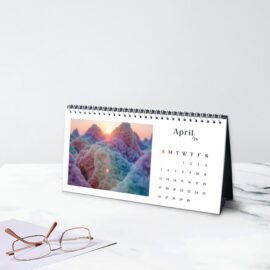
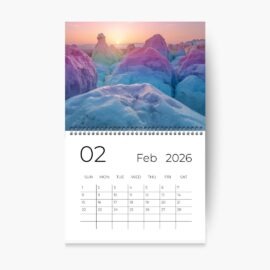
Gooten offers two active formats: a Desk Calendar with 13 customizable pages and a Decorative Wall Calendar with 14 pages. Both use Inkjet Digital Printing and ship worldwide. Compatible with Shopify, Etsy, WooCommerce, TikTok Shop, and BigCommerce.
Desk Calendar vs. Decorative Wall Calendar: Which Format Fits Your Store
The Desk Calendar gives you full layout control across every spread. Typography, imagery, planning grids, monthly quotes — all yours to design. That flexibility is a strength for sellers with a clear visual identity, and a trap for those who treat it as a template exercise. Buyers who receive a desk calendar are looking at your work every day for a year. The design has to hold up.
The Wall Calendar’s 14th page is a cover, and the cover is the most important surface in the product. It’s what appears in your listing photos and what hangs on the wall through December while buyers wait for January. Sellers who design the cover last consistently underperform those who build the entire calendar around it.
Both formats handle full-color photography, detailed illustration, and gradients without limitation. Color inconsistency across pages, the most common complaint in this category, almost always comes from incorrect export settings rather than print quality.
List in August, Not November: The Timing Mistake That Costs Sales
Search volume for custom calendars climbs in October, peaks in November and December, and drops sharply after January. Most sellers list in November, when competition is already at its highest and new listings have no ranking history.
Sellers who publish in August or September arrive at peak season with two to three months of views, favorites, and early sales already behind them. The design work is identical. The timing costs nothing. There is no reason to wait.
Niche Themes That Actually Convert on Etsy and Shopify
Specificity is what separates a calendar that sells from one that sits. A few directions that consistently outperform broad themes:
-
Occupation-specific — nurses, teachers, farmers, veterinarians. These buyers return annually and feel directly seen by a product built around their work life.
-
Hyperlocal photography — a specific city, trail, or region. Demand exists and supply is thin.
-
Breed-specific pets — a golden retriever owner wants twelve months of golden retrievers, not a mixed-breed sampler.
-
Academic year formats — September through August, targeting teachers and students with a summer demand window and far less competition.
-
Life event calendars — wedding planning, baby’s first year, new home. Year-round demand, gift-friendly positioning.
Pricing and Year-Round Sales
Don’t compete with $12 store calendars. A custom POD calendar isn’t the same product. Niche-themed and personalized formats regularly sell at $25 to $45 without resistance, because the buyer isn’t comparing it to a generic option. They’re comparing it to nothing else that serves their specific interest.
The holiday window is the peak, not the only window. Academic calendars sell in summer. Wedding planning calendars sell after engagement season. Baby milestone calendars sell year-round. Fiscal year business calendars serve corporate buyers who don’t start in January. Each of these opens a demand window with less competition than November.
Getting Started with Gooten
Connect your Shopify, Etsy, WooCommerce, or TikTok Shop store, download the calendar templates, upload your designs, set your price, and publish. Orders route automatically to production and ship directly to your customer. No inventory, no minimums, no fulfillment work on your end.
The repeat purchase potential here is real. A buyer who loves your calendar in November has a reason to come back the following August. That kind of annual return visit is rare in POD and worth building toward.
Show More